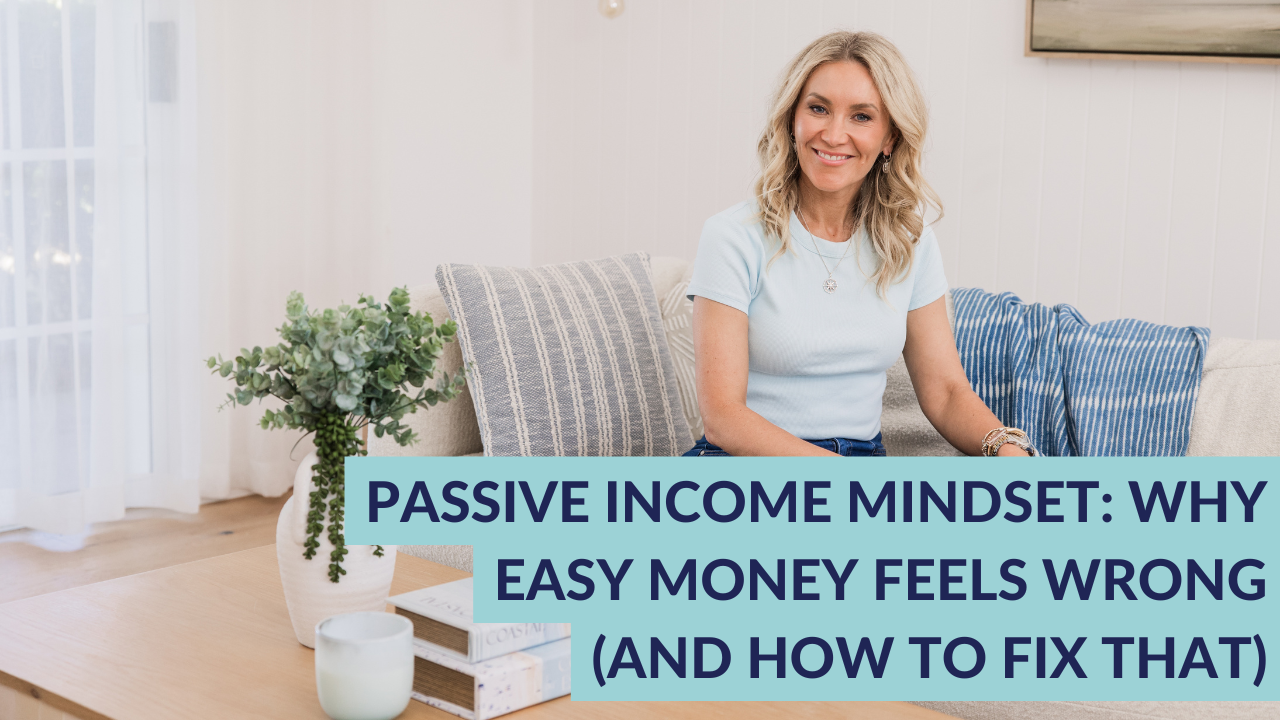
Passive Income Mindset: Why Easy Money Feels Wrong (And How to Fix That)

The first time someone told me I should create passive income, I thought they were talking about something for other people.
Not because I didn't want money to come in without me personally working for it every minute of the day. Obviously I wanted that. But because somewhere deep down, I had this belief that easy money wasn't real money. That I had to exchange hours for dollars, and anything else was cheating somehow.
That belief cost me years.
Now, passive income is a significant part of how my business works. And the shift wasn't primarily strategic. It was a mindset one.
What passive income mindset actually means
Passive income is income that comes in without you directly trading your time for it. Products people buy while you sleep. Programs people join on their own. Books that sell years after you write them.
But here's what a lot of people don't realize: you can know exactly how passive income works, you can have a brilliant product idea, you can understand the business model completely, and still block yourself from actually building it.
Because passive income requires you to believe some things that run counter to a lot of our most deeply held programming.
It requires you to believe that money can come in without suffering. Most of us grew up with "you have to work hard for money." Passive income violates that belief at the deepest level. So your brain, trying to keep you safe inside the beliefs it knows, will find every reason to not finish the product, not launch it, not market it.
It requires you to believe you deserve income even when you're not "on." When you're on holiday. When you're sick. When you're at your kids' school play. When you're just living your life. For a lot of people, especially caregivers and service providers who've built their identity around working hard for others, accepting money for doing nothing feels wrong.
It requires you to believe your knowledge and ideas have value that persists beyond a single transaction. An ebook you wrote two years ago can still help someone today. A course you recorded once can transform someone's life without you personally being there. If your self-worth is tied to showing up and being seen to work, passive income can actually feel threatening, like you're not needed.
It requires you to believe in consistency over intensity. Passive income doesn't usually explode overnight. It builds. Steadily, then more steadily. The entrepreneur who needs the hit of a big launch to feel like their work matters will often struggle with the quieter, slower accumulation of passive income.
Recognize any of that?
The guilt problem
This is the one that gets most people, so I want to spend some time on it.
There's a specific flavor of guilt that comes up around passive income, and I hear it all the time:
"I feel bad charging for something I made once and I'm not actively working on."
"It feels weird to make money while I'm on holiday."
"Someone else is working harder than me and earning less."
I want to gently challenge all of this.
First: the effort went in. You created the thing. You built it, refined it, tested it, figured out how to sell it. The passive income is the return on that work, which is how investment is supposed to function.
Second: you're not "doing nothing." You're maintaining the product, supporting the people who buy it, marketing it, refining it over time. Passive income requires ongoing stewardship. It just doesn't require you to personally trade an hour of time for every dollar earned.
Third: making less so others don't feel left behind is not solidarity. It's guilt-based self-sabotage. Your becoming more financially free doesn't take anything from anyone. If anything, it gives you more capacity to pay your team well, invest in causes you care about, and model what's possible.
Common passive income blocks
"My knowledge isn't valuable enough to sell." You know too much about your topic to see how valuable your beginner knowledge is to someone just starting. What feels obvious to you is a revelation to someone at an earlier stage of the journey.
"My niche is too crowded." There are already a thousand people selling what you do. And yet every year, millions of people buy courses, ebooks, and programs on the most common topics imaginable. What they're buying isn't just information. They're buying your specific voice, your specific take, your specific way of explaining things. That's unique to you.
"I'll do it when I have more time." The passive income product you're waiting to have time to create is the exact thing that will give you more time. This is circular logic at its finest.
"What if people don't buy it?" What if they do? Both outcomes require you to try. The fear of it not working is a very understandable reason to never start. It's also the reason most people's passive income revenue stays at zero.
"It has to be perfect before I launch it." The first version of Money Bootcamp was filmed on a first-generation iPad with terrible sound quality. It still sold. It still changed lives. The tenth version exists only because the first version did.
How to start shifting the passive income mindset
Notice your language around easy money. "Easy money" is not a dirty phrase. It's the whole point. Start paying attention to when you catch yourself thinking that income should be hard, that you should earn your rest time, that making money without working every minute is somehow illegitimate.
Start tiny. You don't need a full course or a membership site. A short guide, a simple ebook, a workshop recording. Something that captures one specific piece of your knowledge and sells for a modest price. The goal of the first passive income product is not revenue. It's building the evidence that this works and you deserve it.
Allow yourself to earn while offline. When you see a payment notification come through and you're doing something completely unrelated to work, practice receiving it with joy rather than guilt. Thank the person in your head. Feel good about it. Don't immediately minimize it.
Understand it takes time to build. Passive income is like compound interest. It's slow at first and then it accelerates. The people who quit after three months because it "isn't working" are the ones who never experience the point at which it becomes genuinely significant.
Connect it to your actual values. Why do you want passive income? What would you do with more financial freedom and time? Get specific and emotional about it. Not "have more money." "Be able to be genuinely present at school pickup without the background anxiety about money."
If you're ready to explore the passive income mindset and start building yours, grab my free guide at denisedt.com/passive. It's a practical starting point.
And for the deeper money mindset work, the belief that easy money is allowed, that you deserve income even when you're resting, that building financial freedom is ethical and good, that's the work we do in Money Bootcamp.
It's your time, and you're ready for the next step.
xx Denise
FREE 3-PART VIDEO SERIES
Rewrite Your Money Story
Discover where your money patterns came from, how they’re affecting your income today, and how to create a calmer, more abundant future.
If money feels harder than it should…
If you earn more but still feel anxious…
If you undercharge, overgive, or constantly second-guess yourself…
It’s not because you’re bad with money.
You’re likely running an old story you never consciously chose.
Start rewriting your money story today...